

It’s budget season. Hoteliers across the country are putting in the extra hours to develop their 2026 budgets. Budgets are the foundation of a hotel’s financial strategy: they set expectations, allocate resources, and provide the framework against which performance is measured.
Advanced tools available today, such as revenue management systems and AI, have made budgeting easier. When I learned how to budget, revenue management systems were in their infancy, and AI was science fiction. This meant most of the work was done manually. I know I’ll date myself by saying this, but budgets were not based on RevPAR growth or RevPAR Index Growth.
Believe it or not, there was a time when RevPAR was a new concept. It wasn’t universally accepted in the hotel industry, nor was it the focal point of budget growth. So, how did hotels budget back then, and what was benchmarked? We used trend analysis for Rooms revenue budgeting.
What is Trend Analysis?
Let’s start with that. Trend analysis is the process of studying historical data over time to identify patterns, shifts, or directions, which helps in forecasting future outcomes and making informed decisions.
When I learned to budget, this was a very manual process that involved entering room nights and revenue data (derived from reports printed out of the PMS with actualized statistics) into spreadsheets. This process is now much more automated with the advanced reporting tools available today.
At the same time, these new, advanced tools may have diminished hoteliers’ skills at forecasting and budgeting. Trend analysis may no longer be considered part of the process, especially when given RevPAR targets in advance, since it often doesn’t tell the whole story.
“Budgets are not based on hope—they should be grounded in trends.”
Trend Analysis in Use
The way I learned was simple. We looked at the last three years of actualized room nights and revenue statistics on a day-by-day basis, broken down by market segment and day of week. For example, I would enter the actualized room nights for the first Monday, first Tuesday, first Wednesday, etc., of a month into a spreadsheet, then do the same for the second Monday, Tuesday, Wednesday, and so on.
Since there are typically four to five weeks in a month, this continued through the fifth week across every market segment: Retail, Negotiated, Government, Discounts, OTA, etc. Once the room nights were entered, I repeated the same process for room revenue. This process was completed for each month of the year. Formulas were used to obtain ADR calculations and the three-year averages for each day.
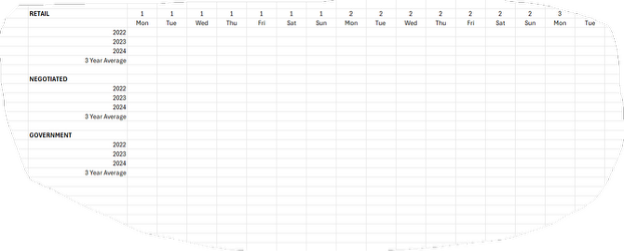
After those steps were completed, we reviewed the averages, identified outliers, and then built our budget based on the strength of the numbers, using either the three-year average or the most recent year’s actual data to build from.
Why is Trend Analysis so Important?
Trend analysis gives hotels the historical trends of recent performance (in my example, three years), to develop realistic budgets. Why is this important? Simply using RevPAR targets to budget is usually not grounded in accuracy. We’ve all heard the saying, “Hope is not a strategy.”
Budgeting solely based on RevPAR targets that don’t use any trend analysis is like shooting in the dark and hoping for the best. Even if a RevPAR target is given, a trend analysis methodology allows for more realistic entries on a day-by-day and market segment basis.
Things to be Aware of When Using Trend Analysis
While using Trend Analysis is important in developing logical budgets, especially at the day-by-day and market segment levels, it’s essential to be aware of certain pitfalls. For example, many holidays shift dates from year to year, which impacts the year-to-year trends and averages. Also, larger hotels, especially those that cater to a lot of group business, will frequently disrupt “typical” transient patterns, which can also throw off the day-of-week averages.
Look out for:
- Shifting holidays: While Independence Day is always on July 4th, that day may land on a Wednesday one year and a Friday another year. Similarly, religious holidays may move around from week to week or month to month from one year to the next. Other holidays, such as Martin Luther King Jr Day or Thanksgiving, are always on the third Monday in January and the fourth Thursday in November, so they have less of an impact on the trend analysis.
- School schedules: Though less disruptive, when schools start and end their academic years may have an impact on transient trends.
- Sports and other special events: Football season is probably the most impactful of sports, with home and away games shifting locations from year to year, and weekend to weekend, making trend analysis difficult to analyze in the fall months. Different teams played from year to year, which can also cause havoc on trends. Same with non-repeating special events.
- Large group blocks: For hotels with a high concentration of group business, we’re familiar with the “peaks and valleys” that groups frequently create. These groups may affect the transient averages on a day-by-day basis. In these cases, looking at monthly averages is also key. For hotels with little to no group business, this is less of a concern.
Being aware of these variables allows hoteliers to adjust their budgets intelligently rather than being caught off guard by predictable shifts and outliers. It can also be beneficial to take marketing metrics into consideration.
Bringing Trend Analysis into the Modern Age
The good news is that hoteliers no longer need to spend hours keying data into spreadsheets the way I did years ago. Today’s tools make the same process faster, cleaner, and more visual. PMS and BI platforms allow you to export daily, segment-level data instantly.
Dashboards can track shifting holidays or school schedules automatically, and RMS tools can model “what if” scenarios—like the Fourth of July falling on a Friday instead of a Wednesday—without rebuilding formulas from scratch.
Modern systems don’t replace the discipline of trend analysis (nor do they replace the need for human-led revenue management), but they do take the heavy lifting out of it. Instead of wrestling with manually entering thousands of numbers into spreadsheets, Revenue Managers can focus on interpreting the patterns and adjusting strategies, bringing efficiency to a process that has always been about accuracy.
“Old-school doesn’t mean outdated—trend analysis is still key to accurate budgeting”
Old-School Tools, Modern Budgets
Trend analysis may feel like an old-school exercise in today’s world of AI and automated reporting, but it remains one of the most effective ways to ground a budget with data. It forces hoteliers to see beyond only RevPAR targets and dig into the patterns that actually impact demand: day of week shifts, holiday impacts, group displacement, and transient behavior.
By combining modern tools with the discipline of trend analysis, hotels can create budgets that are not only aspirational but also achievable in providing a true roadmap rather than just wishful thinking.